Fancy more information?
In his interview with the trade journal ‘fluid’, Carsten Krenz, Technical Managing Director of STAUFF Germany, provides further background information on sustainability at STAUFF.
Background: The success story of the green clamp
In the 1960s, STAUFF launched a green plastic clamp on the market that solved a pressing problem: conventional metal clamps were causing disruptive noise and vibrations in hydraulic systems. The introduction of this solution not only improved operational safety, but also significantly reduced maintenance costs. Working conditions were also improved. This success laid the foundation for the company's innovative strength, which continued in numerous other developments over the following decades.
The step into the future: Recycling clamps made from PP recyclate
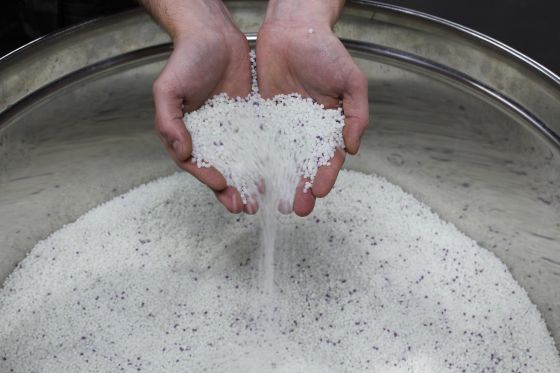
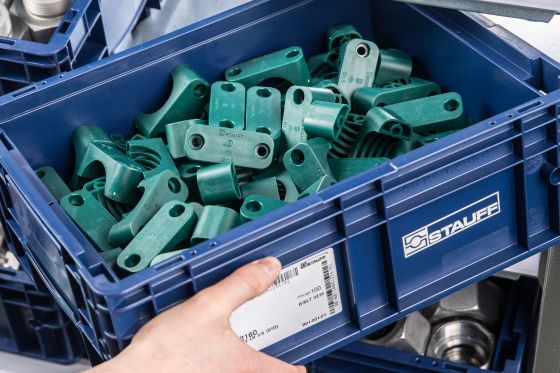
In view of increasing demands for resource efficiency, recycled materials and the reduction of material-related CO₂ emissions, STAUFF has taken the next step in innovation: the development of clamps made from recycled PP. This is an innovative recycling approach that utilises high-quality plastic granulate made from recycled materials.
The challenge lay in finding and developing a material that would meet the stringent technical requirements – particularly in terms of durability and load-bearing capacity. Working closely with renowned partners from the fields of research and industry, the company succeeded in optimising a recycled granulate that meets the technical requirements and has a lower material-related CO₂ equivalent compared with comparable standard materials.
Sustainability as a corporate strategy
The recycled clamp is a key component of the STAUFF Impact Initiative, which focuses on the use of recycled materials, improving resource efficiency and reducing greenhouse gas emissions.
The company aims to reduce Scope 1 and Scope 2 emissions by up to 55 per cent by 2035. In addition to the use of recycled materials in selected products, extensive measures are being implemented to modernise buildings to improve energy efficiency, such as the use of photovoltaic systems, combined heat and power plants and absorption refrigeration systems for heat recovery.
This strategy combines measures for energy efficiency, emissions reduction and the use of recycled materials with economic efficiency, demonstrating that both objectives can be pursued simultaneously.
Technological challenges and solutions
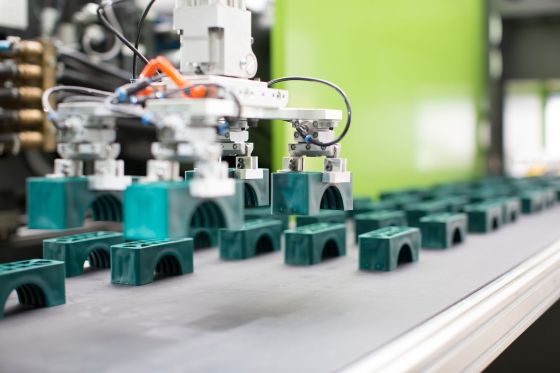
The development of the recycling clamp required in-depth technical expertise and a high degree of innovation. The process began with the identification of a suitable recycling material that would fulfil the high demands in terms of resilience and durability. From the initial idea through extensive testing and prototyping to series production, STAUFF works closely with its customers to develop customised solutions.
Particular attention is also paid to noise reduction: just like the original green clamp, the recycled clamp also helps to reduce disruptive vibrations and noise in hydraulic applications.
Practical examples and areas of application
The recycling clamp is used in a wide range of industries:
Mechanical engineering: Optimisation of hydraulic systems in industrial applications.
Construction industry and agriculture: Use in construction, agricultural and forestry machinery to reduce noise and vibrations.
Municipal sector: Use in electrically powered municipal vehicles that operate quietly and efficiently in residential areas and city centres.
These examples illustrate how the recycled clamp combines technical performance with the use of recycled materials. At the same time, it helps to reduce the product’s carbon footprint compared to clamps made from standard materials and ensures the operational safety of hydraulic systems.
Future prospects: recycling as a possible standard in hydraulics
The development of the recycled clamp marks a milestone that may well redefine the standard in the hydraulics industry. With the continuous development of recycled materials and the experience gained in the process, further product lines with comparable material concepts could be developed in the future. Close collaboration with partners, as well as investment in modern production and energy technologies, demonstrate that STAUFF will continue to work on innovative solutions and continuously refine existing processes and products.
Conclusion: Innovation and resource efficiency
STAUFF demonstrates that economic success, technical innovation and responsible resource management can be successfully combined. From the ‘green’ clamp in the 1960s to today’s recycled clamp, it is clear how technical innovation and the continuous development of material concepts can provide new impetus for the industry.
This success story is not only a testament to STAUFF’s technical expertise, but also an example of how companies can develop forward-looking solutions that combine technical performance, resource efficiency and economic requirements.
All information at a glance
FAQ
What is PP recyclate?
What are the advantages of recycled clamps over conventional clamps?
Recycled clamps combine the technical properties of classic PP clamps with the use of recycled material. Furthermore, an independent CO₂ assessment is available for the PP-ECO material used, which shows a lower CO₂ equivalent compared with the corresponding standard material. At the same time, they offer technical advantages such as improved noise reduction and enhanced operational safety.
How does STAUFF integrate sustainability into its overall strategy?
In addition to developing products using recycled materials, STAUFF is implementing various measures to reduce emissions and improve energy efficiency. These include, amongst other things, the use of photovoltaic systems, combined heat and power plants and measures to modernise buildings to improve energy efficiency. The aim is to reduce emissions in the long term and minimise dependence on external energy suppliers.
Which sectors in particular benefit from recycling clamps?
Sectors such as mechanical engineering, the construction industry and the local authority sector benefit in particular from recycled clamps. They combine the technical properties required for these applications – such as noise reduction, load-bearing capacity and operational safety – with a material that has a lower material-related CO₂ equivalent compared with equivalent standard materials.
Can the recycling clamp be established as the standard in the hydraulics industry?
Developments to date and practical experience show that recycled clamps can meet the technical requirements of many hydraulic applications. With the further development of recycled materials and growing experience in their application, the recycled clamp could, in the long term, become established as one of several standard solutions in the hydraulics industry. This development is accompanied by investment in modern and energy-efficient production technologies.
Can customers obtain independent confirmation of Co ₂ reduction?
Yes, an independent CO₂ life cycle assessment is available for the PP-ECO material used. This shows a significantly lower material-related CO₂ equivalent compared with a corresponding standard PP material. The relevant documentation can be provided to customers on request.

Newsletter registration
Register now and never miss a new blog post from STAUFF again